Casual Apparel Inspired by The Feizi Gallery's Discovery and Promotion of Chinese Contemporary Art
Art Inspired Casual Apparel : The Feizi Collection
Our goal was to create a casual clothing line inspired by the fine art world, and particularly influenced by the works of Chinese contemporary artists, many having had exhibits at the Feizi Gallery in Shanghai. Some of these artists include Luo Fahui, Jiang Yong, Feng Feng, Lu Biaobiao and Liu Qingyuan. Our collection does not directly involve images from these individual artists, but attempts to create a sensibility of the genre that was popular in 2008 - 2018, which influenced art trends in many Asian cultures at the time. Some of the common themes include color palette, soft focus, highly contrasting interruptive elements applied in layers, surreal environments, and an exotic sensitivity over all.
These design elements are ideal for high end casual wear - whether the need is a complete outfit or just a t-shirt, business casual attire for men, or fashion-ready outerwear for women. The Feizi Collection believes clothes make a statement, and that statement is style, with attention paid to comfort for those who choose to forget the dress code and instead dress casually.
Check out the Feizi Collection of jeans and denim skirts. Our entire wardrobe is all cotton and comes in colors both attention-grabbing and subdued. There are eye-catching outfits combining dresses, shoes, pants and accessories.
A restoration of the Feizi Gallery website was created to preserve some of what this influential gallery was up to. A partial archive from the original site is below:
Located in Shanghai at 55 Fuxing West Road, in the former French concession cultural and diploma district, the Feizi Gallery had been dedicated since 2007 to the discovery and promotion of Chinese contemporary art on the international scene. The collections at the gallery bring together the established and emerging talents of painting, sculpture, and photography. The Feizi Gallery allowed a better understanding and diffusion of the Chinese artistic scene.
For a number of years this was the gallery's website.
Content is from the site's archived pages.
"Art that grows on you"
55 Fuxing Road
West Shanghai PRC(200031)
Tel:86-21-64316661
OVERVIEW
The FEIZI Gallery was located in an old foreign-style house at 55 Fuxing West Road. This road, which was once part of Shanghai’s former French concession, is now surrounded on both sides with the consulates and cultural organizations of several countries. The environment is thus refined, elegant and artistic.
STORY
The FEIZI Gallery was established in these ideal quarters in July, 2007. The main focus of the gallery is to discover and promote Chinese contemporary artists, who each have their very unique and individual artistic style. The principal objective of the promoters of the FEIZI Gallery is to recommend hand-picked contemporary Chinese collections that have the greatest potential interest and value for the international market and to enhance understanding and appreciation of Chinese contemporary artworks.
OBJECTIVE
Our ultimate objective is thus to serve as a platform for international cultural exchange. On the one hand, the FEIZI Gallery recommends and promotes the works of Chinese artists in order to play a leading role in the development of Chinese contemporary art, whilst on the other hand it will enhance cooperation with international artistic organizations, in order to provide a space for art amateurs and collectors alike.
CASUAL APPAREL : THE FEIZI COLLECTION
In an effort to bring the design sensibility of Chinese contemporary art to a mass market audience, the Feizi Collection was conceived to offer a wide range of very high quality casual clothing, marketed via digital strategies targeting teen / young adult consumers. While marketed broadly, the apparel in the Feizi Collection are luxury items. Specific products include comfortable leisure shirts, pants, sweatshirts, sweatpants, t-shirts, hoodies, and related sportswear. Our high end informal lifestyle clothing is worn every day by men and women who appreciate design and functionality. While targeted to the young, it is agelessly practical with classic appeal. We're going to the gym or to the beach, or hanging out watching Netflix. Living life.
Get the latest FEIZI Gallery news and events. Sign-up for our monthly newsletter and keep on top of what’s happening in Chinese contemporary art.
ARTISTS:
Cang Xin
He Yunchang
Yang Qian
Qin Ga
Jiang Yong
Luo Fahui
THE FEIZI COLLECTION : APPAREL
Inspired by the unique contemporary art scene in West Shanghai, our casual line of sportswear carries its own cachet that will be recognized by the color palette and design flourishes that inhabit this creative realm, Fiezi. In addition to the most popular casual pants, shirts, dresses, gym-wear, we are looking into the feasibility of including some casual footwear like boots & sneakers via licensing agreements with manufacturers. Currently available apparel includes accompanying items like skirts, sweaters, and accessories. There are also some specialty areas in development, including fleece, jackets and other outerwear, hats/caps. Digital marketing is underway in a video campaign focused on stylish exercise featuring matching sweatpants and hoodies.
Exhibits 2010 - 2011
Doom Of Spring Flourish
Wednesday
1 September 2010
5:00 pm
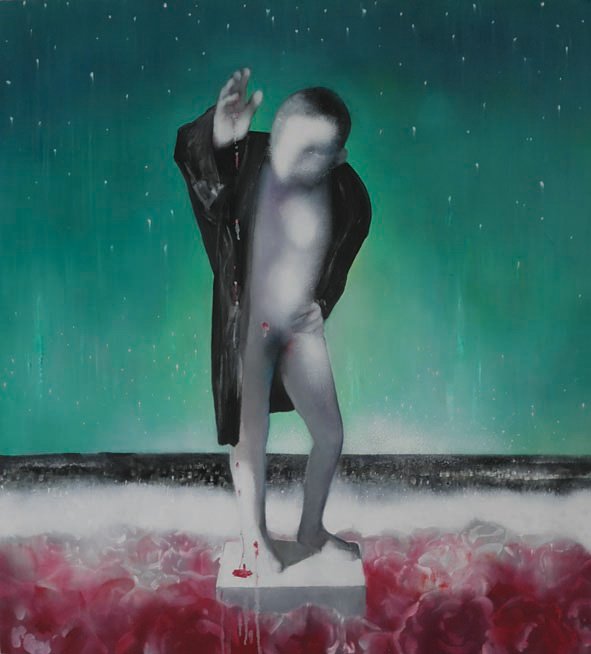
The Feizi Gallery is pleased to present the works of Chinese contemporary artist Luo Fahui through the upcoming solo exhibition "The Doom of Spring Flourish".
Luo Fahui was born in 1961 in Chongqing, China. He graduated from the oil painting department of the Sichuan Fine Arts Institute in 1985, and his works have since been exhibited both China as well as Madrid, London and Brussels.
Curator: Wang Lin
+++
SOMEWHERE, SOMETIME, SOMEBODY: JIANG YONG WORKS EXHIBITION (group).
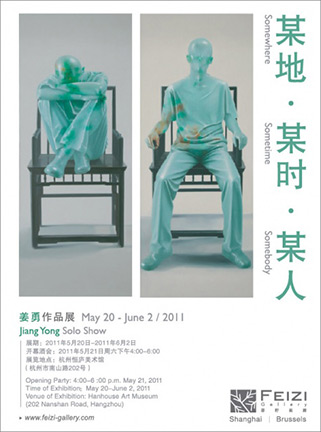
20 May 2011 - June 2
Venue(s) HanHouse (Hangzhou, China)
Artist(s) Jiang Yong
Organizer(s) FEIZI Gallery (Shanghai, China)
About Somewhere, Sometime, Somebody: Jiang Yong Works Exhibition
As accurate as words are, they cannot always succeed in being the expression of deeper perceptions, impressions and feelings; those are hidden in remote waves of consciousness that only art can reach. Jiang Yong’s artworks are the imperceptible’s reflection. He understands that the power of art is the one that conveys the unutterable: all the things we cannot tell, only sense.
Subtle and profound, Jiang Yong communicates through the peaceful yet intriguing bodies and faces the spirituality and the simplicity we need to touch the unspeakable. The paintings remind the Chinese philosophy that inspired him, glorifying the power of the essential: the human beings made of jade are dense and soft at the same time, just as the pure and simple individual. Following the rhythm of the artist’s mental state, Jiang Yong’s artworks reveal the impulse of creation to achieve stability. They question notions such as sensation, purity, subconscious and truth. He uses art to define the undetectable, to enhance its beauty and specify what it requires to be illuminated: contemplation, calm and simplicity. The quintessence of mind lies therefore in his paintings.
Playing with talent with space and volume, exploring the infinite possibilities of illusion and blur, Jiang Yong creates a tension between precision and rawness to transmit the unclear, abundant, untrammeled and fascinating hidden profound life and complete his and our inner harmony
+++
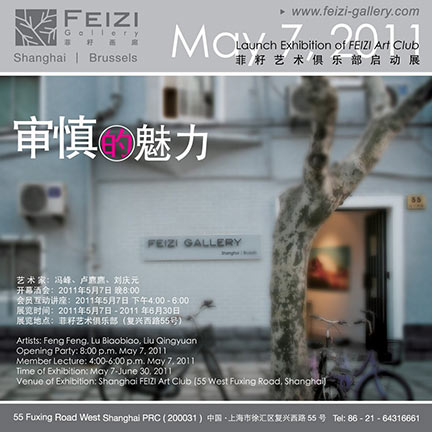
Exhibition of contemporary Chinese art : Feng Feng, Lu Biaobiao and Liu Qingyuan. Music by Australian DJ R3.
Saturday
7 May 2011
11:00 am - 7.00 pm
The FEIZI Gallery, a Chinese, French and Belgian gallery specialized in emergent contemporary Chinese and international artists, launches the FEIZI Art Club, dedicated to art lovers and whoever desires to enter the privileged and fascinating world of art.
On this occasion, the gallery organizes the exhibition THE CHARM OF CAUTIOUSNESS from May 7th to June 30th.
Feng Feng, Lu Biaobiao and Liu Qingyuan will reveal their artworks, on the three floors of a beautiful French-style house. Space, memory, life and society are questioned through unexpected, surprising and talented paintings, sculptures and street art. Innovation and reflection define their work.
You are cordially invited to the Opening Party on May 7th at 8:00 pm : the Australian DJ R3 will play his music while letting you discover Chinese contemporary art at its best. The exhibition will last until June 30th.
Press Release
Contemporary Chinese Works at FEIZI Gallery
By carlonseider
Wed, Aug 31, 2011
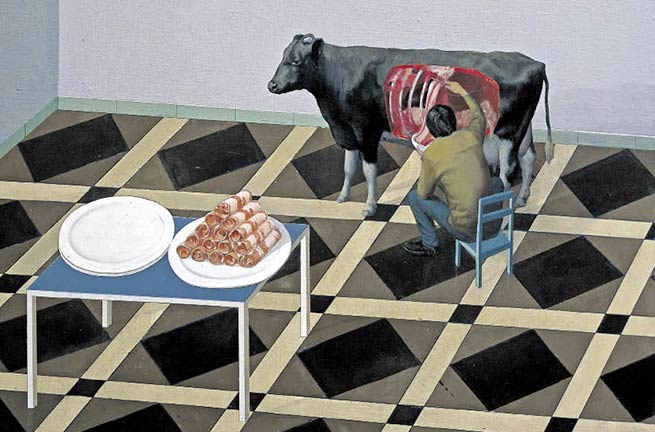
”Experimental Painting Manual” showcases the work of three contemporary Chinese artists over three floors, a floor for each artist. The ground floor is for Chongqing-born Wang Jun’s tranquil black, grey and white canvases. Almost abstract in execution, Wang’s pieces depict doors, walls, vents and brickwork. They are the calm before the storm of color and imagery that awaits upstairs, showing that Chinese contemporary art is far more diverse than many critics would postulate. Huang Yishan’s gruesome mixed media works on the second floor are a shock to the system. Wang Jun’s quiet monochromes contrast with Huang’s striking images: a naked man being chopped in half by a surgeon in a macabre re-enactment of a magic show, a woman cutting a man’s throat as he struggles on a table and a man shaving ribbons of meat from a cow’s side. Each painting shows a room, and each room is divided into a tiled floor with a detailed pattern, a block-color wall at the top and more tiling in between. Most meaningful are the pieces you come to last–a studio drenched in blood with the artist peering in through the door. Here Huang expresses art as pain and artistic expression as the letting of blood. More subversively, it's also a veiled dig at the commercialization of the art world. Born in Guangdong in 1983, Huang is the youngest artist in the show, but his work lacks the naïveté typical of less experienced painters. The top floor is dedicated to oil paintings by Shen Liang. Born in 1976 in Liaoning, Shen has displayed in New York and Frankfurt as well as Beijing and Shanghai. His rebellious streak manifests itself in the scratches and marks he makes on his paintings once they’re complete (look for irreverent placements of his signature in the middle of a piece and for beacons of modern culture like the words “Gucci” and “iPod”). Shen believes that vandalizing one’s own art is liberating, relaxing and–most interestingly–anti-establishment. Most of his oil paintings feature propaganda images and scenes from classical painting reworked with messily placed daubs of paint. The further you stand away the more realistic they look. Note: Today is the last day of this exhibit, but you can head to the [FEIZI Gallery](http://www.cityweekend.com.cn/shanghai/listings/art/galleries/has/feizi-gallery/) Mon-Sun 11am-7pm to check out other cool contemporary Chinese art.
Feizi's Casual Apparel Draws From Contemporary Chinese Art
The Feizi world is a wonderfully serene landscape conforming to the genuine pleasure of comfortable clothing. It's why we hate dress codes and love casual Fridays. We know how to dress up when the occasion warrants such, but most of our lives is spent within the sphere over which we exert some limited control. And we know what we like. Especially when it comes to choosing a daily outfit, the preferred uniform of the casual spirit. We are looking for smiles, so we avoid too tight like the plague. We are the untucked shirt, the zero makeup face, the occasional slob. Somewhere between casual-in-the-extreme and a requirement for formal attire is our vast wonderland of sensuous palettes and subtle flourishes, one that honors a recognizable art culture, unique to Shanghai in 2007 - 2011. It is the essence of the legendary Fiezi Gallery. We've captured that essence in a line of casual wear reminiscent of an influential art culture, thriving during a special time, in a special place. Relax in Feizi sweats, polos, hoodies, jeans and live large, casually.
Seen on the streets of New York, Paris, Shanghai - the Feizi Collection - Casual Apparel inspired by Contemporary Chinese art trends. Comfortable clothes for the casual lifestyle.

More Background On Feizi-Gallery.com
Feizi-Gallery.com is not a typical commercial gallery website nor a simple fashion storefront. Instead, it operates as a hybrid cultural archive, lifestyle brand platform, and historical record, preserving the legacy of one of Shanghai’s notable contemporary art galleries from the late 2000s while extending its aesthetic philosophy into fashion and digital culture.
At its core, the website reflects two intertwined identities:
-
The historical Feizi Gallery, founded in Shanghai in 2007, which played an important role in presenting Chinese contemporary art to an international audience during a critical period of global interest.
-
The Feizi Collection, a fashion and lifestyle line inspired by the visual language, mood, and cultural sensibilities cultivated by that gallery and its artists.
Together, these dimensions make Feizi-Gallery.com a valuable resource for researchers, collectors, curators, fashion observers, and anyone interested in how contemporary art ecosystems evolve into broader cultural brands.
Origins and Ownership: From Physical Gallery to Digital Preservation
The Feizi Gallery was established in 2007 in Shanghai during a moment of rapid expansion for China’s contemporary art market. This era saw unprecedented international attention focused on Chinese artists, particularly painters and mixed-media practitioners working at the intersection of tradition, conceptual art, and global modernism.
While ownership details were never heavily commercialized or celebrity-driven, Feizi Gallery operated as a privately run, curator-led gallery, shaped by European and Chinese collaboration. Its founders and promoters positioned the gallery as both a discovery platform for emerging artists and a bridge between Chinese creative practice and Western collectors, critics, and institutions.
Feizi-Gallery.com today reflects a restoration and archival effort, preserving materials from the original gallery’s online presence while expanding into new territory through branding and apparel.
Location and Cultural Geography: West Fuxing Road, Shanghai
The original gallery space was located at 55 Fuxing West Road, within Shanghai’s former French Concession—an area historically associated with diplomacy, culture, architecture, and international exchange.
This location mattered.
The neighborhood was (and remains):
-
Home to foreign consulates
-
Surrounded by cultural institutes and historic villas
-
Known for its quiet, refined atmosphere, distinct from commercial gallery clusters
The gallery occupied a foreign-style residence, reinforcing an intimate, salon-like exhibition experience rather than a white-cube commercial model. This physical environment shaped the gallery’s identity and aligned closely with its curatorial focus on introspection, subtlety, and psychological depth in contemporary Chinese art.
Curatorial Mission and Goals
Feizi Gallery’s mission centered on three primary objectives:
Discovering and Promoting Chinese Contemporary Artists
The gallery emphasized individual artistic voices, particularly painters whose work explored:
-
Inner consciousness and emotion
-
Surreal or dreamlike figuration
-
Philosophical abstraction
-
Psychological realism
Rather than trend-chasing, Feizi favored artists whose work “grew on the viewer”, aligning with the gallery’s long-term approach to collecting and appreciation.
Serving as a Platform for International Exchange
From its inception, Feizi Gallery positioned itself as a cultural intermediary, working with curators, collectors, and institutions across Europe and Asia. This included:
-
International exhibitions
-
Collaborative events outside Shanghai
-
Cross-cultural curatorial dialogue
Enhancing Understanding of Contemporary Chinese Art
Beyond sales, the gallery focused on education and context, often framing exhibitions with philosophical or conceptual narratives rather than purely market-oriented language.
Artists Associated with Feizi Gallery
Feizi Gallery represented and exhibited a range of artists whose practices reflected the diversity of Chinese contemporary art in the late 2000s. Artists frequently associated with the gallery included:
-
Luo Fahui – Known for psychologically charged figurative painting
-
Jiang Yong – Explored spirituality, human essence, and stillness
-
Feng Feng – Investigated social space and abstraction
-
Lu Biaobiao – Integrated memory and environment
-
Liu Qingyuan – Examined urban and emotional landscapes
-
Cang Xin, He Yunchang, Qin Ga, Yang Qian – Artists connected through exhibitions or related programming
These artists were often shown in solo and thematic group exhibitions, reinforcing Feizi’s emphasis on depth rather than volume.
Exhibitions and Programming
Between 2007 and 2011, Feizi Gallery hosted and organized exhibitions that reflected its curatorial philosophy.
Notable programming included:
Solo Exhibitions
Solo shows allowed artists to present cohesive bodies of work, often accompanied by curatorial essays emphasizing psychological, philosophical, or poetic interpretation.
Group Exhibitions
Thematic exhibitions brought together multiple artists around shared concepts such as:
-
Memory and perception
-
Stillness and motion
-
Inner versus outer reality
Some exhibitions extended beyond Shanghai, demonstrating Feizi’s commitment to broader cultural circulation.
Cultural Events and Performances
Feizi Gallery occasionally integrated music, performance, and social gatherings into exhibition openings, reinforcing its role as a cultural salon rather than a purely commercial venue.
Press Coverage and Media Attention
During its active years, Feizi Gallery received coverage from:
-
Shanghai cultural listings and art guides
-
International expat-focused publications
-
Contemporary art critics writing about emerging Chinese art
Reviews frequently emphasized:
-
The intimacy of the gallery space
-
The intellectual seriousness of the exhibitions
-
The contrast between Feizi’s contemplative approach and more market-driven galleries
Press descriptions often highlighted how Feizi Gallery challenged simplistic Western narratives about Chinese contemporary art, presenting it instead as diverse, introspective, and philosophically grounded.
Audience and Community
Feizi Gallery attracted a distinct audience profile:
-
International collectors and curators
-
Shanghai-based expatriates interested in contemporary culture
-
Chinese art students and practitioners
-
Culturally engaged locals seeking alternatives to commercial art districts
This audience valued context, conversation, and discovery, rather than spectacle or hype.
Transition to Digital Legacy and Archival Presence
As Shanghai’s gallery landscape evolved and market conditions shifted, Feizi Gallery ceased operating as a permanent physical space. However, its cultural influence did not disappear.
Feizi-Gallery.com functions today as:
-
A digital archive of exhibitions and philosophy
-
A historical snapshot of a formative period in Chinese contemporary art
-
A brand extension translating visual culture into lifestyle products
This preservation effort aligns with a growing recognition that gallery websites themselves are cultural artifacts, documenting movements, aesthetics, and curatorial thought.
The Feizi Collection: Art-Inspired Casual Apparel
One of the most distinctive aspects of Feizi-Gallery.com is its evolution into The Feizi Collection, a fashion and lifestyle brand inspired by the gallery’s aesthetic world.
Concept and Design Philosophy
The Feizi Collection draws inspiration from:
-
Color palettes common in Chinese contemporary painting
-
Layered visual structures and soft focus
-
Contrasting elements and surreal atmospheres
-
A refined yet relaxed sensibility
Importantly, the clothing does not reproduce specific artworks, but instead translates the mood and philosophy of an art scene into wearable form.
Product Categories
The collection emphasizes high-quality casual wear, including:
-
T-shirts and tops
-
Sweatshirts and hoodies
-
Pants, jeans, skirts
-
Leisure and sportswear
-
Accessories and outerwear concepts
Materials are typically cotton-based, prioritizing comfort without sacrificing design coherence.
Target Audience
While marketed toward teen and young adult consumers, the clothing is intentionally age-agnostic, appealing to anyone who values:
-
Art-influenced design
-
Comfort over formality
-
Subtle visual identity
The brand embraces everyday life—gym visits, casual socializing, creative work—rather than formal occasions.
Cultural and Social Significance
Feizi-Gallery.com represents a broader cultural phenomenon:
Art Beyond the Gallery
The site demonstrates how gallery culture can extend into fashion, lifestyle, and digital memory, preserving artistic influence beyond physical walls.
Documentation of a Key Era
The gallery’s active years coincide with a critical decade (2007–2011) when Chinese contemporary art gained global visibility. Feizi’s archive helps contextualize that moment.
Hybrid Identity
By merging archive, brand, and philosophy, Feizi-Gallery.com occupies a space between:
-
Art history
-
Cultural branding
-
Digital preservation
This hybrid model is increasingly relevant as many influential galleries of the early internet era no longer exist physically.
Reputation and Lasting Impact
While Feizi Gallery was never a mass-market institution, its reputation rests on:
-
Thoughtful curation
-
Respect for artistic individuality
-
Cross-cultural dialogue
-
A refusal to reduce art to trend or commodity
Among those familiar with Shanghai’s art history, Feizi is often remembered as a quietly influential space—one that prioritized substance over spectacle.
Why Feizi-Gallery.com Matters Today
Feizi-Gallery.com is more than a legacy website. It is a cultural document, a branding experiment, and a living archive that preserves the ethos of a gallery deeply embedded in a transformative period of contemporary Chinese art.
For researchers, it offers insight into curatorial practices and exhibition histories.
For designers, it demonstrates how art sensibility can translate into wearable form.
For collectors and enthusiasts, it preserves a moment when Shanghai stood at the crossroads of global contemporary culture.
In an era when many galleries vanish without trace, Feizi-Gallery.com stands as a reminder that art history can—and should—be preserved in evolving, creative ways.